 How-to
How to Jump Start a Car Safely Without Damaging the Battery
Last Updated: November 9, 2026
Quick Summary
To jump start car safely, connect the red clamp to the positive terminal of the dead battery, the second red clamp to the positive terminal of the good battery, the black clamp to the good battery's negative terminal, and the last black clamp to an unpainted metal ground point on the dead car. Leave the cables connected for about two to three minutes before starting the engine.
- Set both vehicles in park with the parking brake on and the ignition off before connecting any cables.
- Never clamp the final black lead to the dead battery's negative post; use bare metal instead.
- Disconnect the cables in reverse order once the revived car is running.
- Drive at highway speed for 20 to 30 minutes to recharge rather than idling in a parking lot.
- Stop after two failed attempts and get a professional diagnosis instead of jumping again.
Table of Contents
- Safety Checks Before You Connect Any Jumper Cables
- How to Jump-Start a Car with Jumper Cables in the Correct Order
- How Long to Leave Jumper Cables Connected Before and After Starting
- How to Jump-Start a Car with a Battery Pack Instead
- What to Do If a Car Won't Start After a Jump
- Request a Jump Start from Bebanoch Roadside
- Frequently Asked Questions
Safety Checks Before You Connect Any Jumper Cables
A dead battery can happen in any parking lot, and knowing how to jump start car safely starts with a few checks before you touch a cable. The first rule is simple: stop and look before you clamp anything. A jump start is the act of boosting a weak vehicle battery with power from a second, working battery so the engine can turn over again.
Here is what to confirm before you open the hood:
- Both vehicles are in park, with the parking brake set.
- The ignition is off in both cars, along with lights, radio, and electrical accessories.
- The batteries are not cracked, leaking, or frozen.
Check the Battery Condition First
Before you connect anything, look at the battery case itself. A healthy battery is a sealed, square block with no bulging, no wet spots, and no crusty white or blue-green buildup around the posts.
Cold weather adds a specific hazard. A battery that has been sitting in freezing temperatures can freeze solid, and a frozen battery can crack or rupture when a boost sends current through it.
Inspect the Cables and Know Their Limits
Jumper cables are not all the same. A set rated for a small sedan may not carry enough current for a full-size truck or an SUV with a larger engine.
Watch out: never let the red and black clamps touch each other while any clamp is connected to a battery. That dead short can weld the clamps together, melt insulation, and cause a burn or fire.
When Not to Jump-Start a Battery
Some batteries should never get a boost. Skip the cables if the battery case is cracked, leaking fluid, or visibly damaged.
Modern hybrids and EVs need extra care. Many have separate high-voltage systems, so check the owner's manual before you connect anything.
If your battery is too far gone to hold a charge, a boost will not fix it. Our team can handle a dead battery and get you moving without the guesswork.
How to Jump-Start a Car with Jumper Cables in the Correct Order
Learning how to jump-start a car with jumper cables comes down to one thing: the order of the clamps. Get the sequence right and you avoid sparks, a short circuit, and battery damage.
Positioning the Vehicles and Locating the Terminals
Park the two cars nose to nose or side by side, close enough for the cables to reach with slack. Never let the vehicles touch. Set both in park (or neutral for a manual transmission), engage the parking brake, and shut off the ignition.
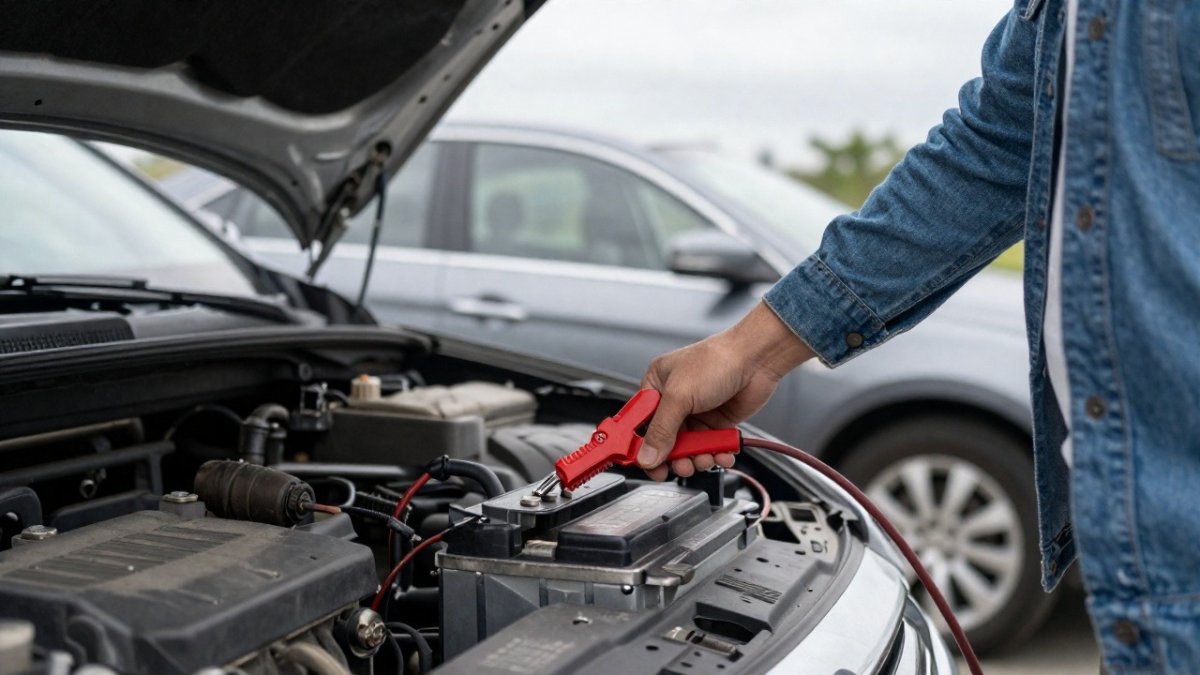
Open both vehicle hoods and find the batteries. Look for the terminal markings: positive terminal (often red, marked POS or +) and negative terminal (often black, marked NEG or -). Remove any battery cover first.
The Four-Clamp Sequence and the Ground Point
Connect the clamps in this exact order:
- Red clamp to the positive terminal of the dead battery.
- Red clamp on the other end to the positive terminal of the good battery.
- Black clamp to the negative terminal of the good battery.
- Black clamp to an unpainted metal ground point on the dead car, such as a clean bolt on the engine block. Never clamp the last lead to the dead battery's negative post.
That last step is what keeps sparks away from the battery. The ground point must be bare metal, not paint or plastic.
Connect the four clamps in this exact order to keep sparks away from the battery.
| Step | Clamp | Connect to |
|---|---|---|
| 1 | Red | Positive terminal of the dead battery |
| 2 | Red | Positive terminal of the good battery |
| 3 | Black | Negative terminal of the good battery |
| 4 | Black | Unpainted metal ground point on the dead car |
How Long to Leave Jumper Cables Connected Before and After Starting
Leave the cables connected for about two to three minutes before you try to start the dead car. This lets the good battery push a little charge across. Then start the engine on the dead vehicle.
If it starts, keep both engines running and leave the cables on for a few more minutes. This gives the charging system time to stabilize.
How Long to Run the Car After a Jump
A common mistake is shutting the revived car off as soon as it starts. The alternator needs time to replace the energy the jump borrowed, and idling in a parking lot is the slowest way to do it.
Watch out: if the engine cranks slowly or not at all after a few tries, stop. Repeated attempts can damage the starter.
Troubleshooting When the Car Still Will Not Start
A jump does not always solve the problem, and the symptom tells you where to look next.
- One click, then nothing. A single loud click with no crank often points to a starter solenoid or a poor connection at the battery terminals. Recheck that the clamps are tight and on bare metal before assuming the starter is bad.
- Rapid clicking. A fast chatter usually means the battery is too low to hold the starter engaged. The jump may not have transferred enough charge, or the battery is failing.
- No crank and no dash lights. If the dash stays dark after connecting, the battery may be completely dead or the cables may not be making contact. Confirm the ground point is bare metal, not paint or plastic.
If the car starts but the battery warning light stays on, the alternator may not be charging. In that case, drive straight to a service location rather than shutting the car off, because it may not restart.
When to Stop Jumping and Call for Help
Repeated jumps on a failing battery wear down the starter and the charging system, and they waste your time. If two attempts do not get the engine running, stop and get a professional diagnosis. You can request roadside assistance for a no-start.
How to Jump-Start a Car with a Battery Pack Instead
A portable jump starter skips the second vehicle entirely, which makes it the easier route when you are alone. Learning how to jump-start a car with a battery pack is faster than cables and safer for newer electronics.
Here is the routine:
- Turn the pack off and confirm it is charged.
- Connect the red clamp to the positive terminal.
- Connect the black clamp to a ground point on bare metal.
Many packs include reverse polarity protection, so a wrong clamp will not fry the electronics. A battery charger is the better choice when you have time to recharge slowly at home.
What to Do If a Car Won't Start After a Jump
A car that will not start after a jump usually points to a battery that cannot hold a charge, a bad connection, or a deeper problem with the starter or charging system. Work through these checks:
- Are the clamps tight and on bare metal?
- Is the donor vehicle battery actually good?
- Do the dash lights come on at all?
If the lights are dead, the battery may be finished. If it clicks but will not turn over, the starter is a likely suspect. A battery that dies again within a day often means the charging system needs a look.
At that point, stop boosting and get a professional diagnosis. Repeated jumps on a failing battery wear down the system and waste your time.
Request a Jump Start from Bebanoch Roadside
When the cables are not enough, hand the job to us. Bebanoch Roadside offers 24/7 roadside assistance across Indiana.
Here is what makes it easy:
- Live GPS tracking shows exactly where your provider is.
- A vetted service provider network provides the service.
- A smart vehicle profile is available for requests.
Older drivers who prefer not to use an app can simply call. And if you have questions before you request, contact our team for a quick answer.
A dead battery is stressful, but you do not have to manage it alone in traffic or bad weather.
Frequently Asked Questions
What is the safest way to jump start a car?
Park the two vehicles so they do not touch, turn off both ignitions and electrical accessories, and set the parking brake. Connect the red clamp to the dead battery's positive terminal, the other red clamp to the good battery's positive terminal, the black clamp to the good battery's negative terminal, and the final black clamp to an unpainted metal ground point on the dead vehicle. Start the good engine, wait a few minutes, then start the dead vehicle. Remove the cables in reverse order.
Can you jump-start a car by yourself?
Yes, if you have a portable jump starter battery pack. Clamp the red lead to the positive terminal and the black lead to a ground point or negative terminal, then start the engine. Without a second vehicle or a battery pack, you cannot complete a traditional cable jump alone. Many drivers keep a charged jump pack in the trunk for exactly this reason, and roadside services can also send a technician with one.
How long should you leave jumper cables connected?
Leave the cables connected for about two to three minutes with the good engine running before you try to start the dead vehicle. After it starts, keep the cables on for another minute or two, then disconnect in reverse order. Driving the revived vehicle for at least 20 to 30 minutes afterward gives the alternator time to recharge the battery.
When should you not try to jump-start a car?
Skip the jump if the battery is cracked, leaking, or visibly frozen, or if you smell rotten eggs near it. Do not jump a hybrid or EV using a standard 12-volt cable procedure without checking the owner's manual, since high-voltage systems need different handling. If the battery terminals are corroded or the cables are frayed, call a professional instead of risking sparks or a short circuit.