 How-to
Avoid Surprise Towing Fees: Know Your Rights Before the Hook
Last Updated: November 12, 2026
Quick Summary
Avoid surprise towing fees by getting the total price in writing before the hook goes on, since a quote is only an estimate and the final bill can include mileage, winching, and storage extras. Ask whether the number is the total or the starting point, and keep an itemized receipt to dispute charges later.
- A quoted price may cover only the hookup, not the tow itself.
- Ask if the price is the total or the starting point.
- Storage fees usually start when the vehicle reaches the impound lot.
- Roadside coverage typically reimburses up to a set limit per tow.
- Send a written dispute to the towing company with a 10 business day deadline.
Table of Contents
- Why Surprise Towing Fees Happen and How to Spot Them Early
- Tow Truck Quote Questions to Ask Before You Agree
- Towing Storage Fees Per Day: What Drives the Meter Up
- Roadside Assistance Towing Coverage: What Insurance Actually Pays
- How to Dispute a Towing Bill Step by Step
- Predatory Towing Practices and the Consumer Rights That Stop Them
- Request Transparent Roadside Help Before the Hook Goes On
- Frequently Asked Questions
Why Surprise Towing Fees Happen and How to Spot Them Early
The final bill for a tow often comes as a shock because the number you agreed to and the number you pay are two different things. This commonly happens when a driver accepts a verbal quote without asking what it covers. Learning to avoid surprise towing service fees starts with one habit: get the number in writing before the hook goes on.
The gap usually comes from three places:
- A quoted price that covers only the hookup, not the tow itself
- Mileage surcharges added after the truck is already moving
- Storage fees that start the moment your car hits the impound lot
Spot these early by asking one blunt question: "Is this the total, or the starting point?" A straight answer tells you a lot.
The Difference Between a Quote and a Final Bill
A quote is an estimate. A final bill is what you owe. The two drift apart when the towing service agreement leaves room for extras.
A base rate or hookup charge is the flat fee to attach your vehicle. Everything else, including mileage, winching, and storage, may sit outside that number. A non-consensual tow, where your car is taken from private property without your say-so, follows a different set of rules than a tow you request yourself.
Watch out: a driver who won't put the total in writing before loading your car is telling you something. Ask for the itemized receipt terms up front, not after.
Tow Truck Quote Questions to Ask Before You Agree
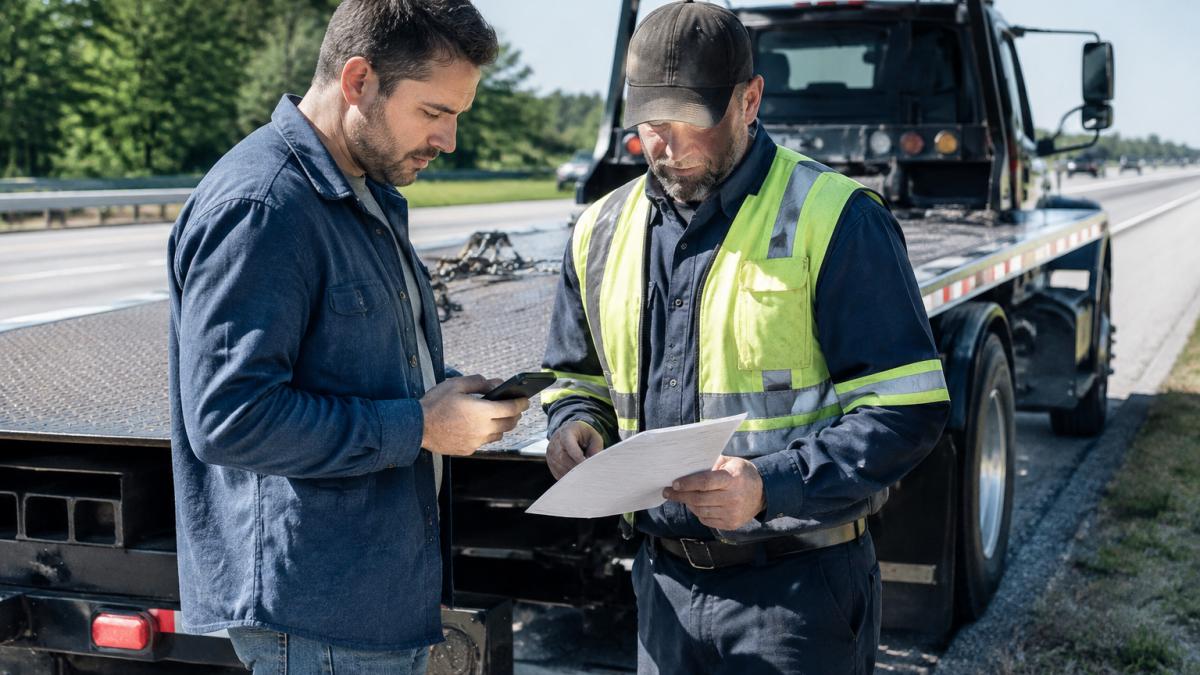
Ask these tow truck quote questions before you say yes, and you close most of the gap between the quote and the bill. The answers should be specific numbers, not "it depends."
- What is the total, including mileage and any winching?
- Is there a drop fee if I cancel or change my mind?
- How far is the tow, and how is mileage calculated?
- Where will the vehicle go, and what does storage cost per day?
- What payment methods do you accept, and are card fees extra?
- Can I get an itemized receipt before you load the car?
Write the answers down. A towing invoice that matches your notes is your best defense later.
The Documentation Checklist for Disputes
Disputes are won or lost on paperwork. Build the file before you pay, not after. Most guides skip this, and it costs drivers real money.
- Photo of the tow signage where the car was taken
- Photo of your car's position and any posted warnings
- The driver's name, company, and towing license number
- The written quote and the final itemized receipt
- Time stamps for the hookup and the vehicle release
- Payment record, whether card or cash
Keep every photo with a date stamp. If you later file a dispute charge with your card issuer, this file does most of the arguing for you.
Towing Storage Fees Per Day: What Drives the Meter Up
Storage fees per day are the charge that quietly grows while you sort out payment. The meter usually starts when the vehicle reaches the impound lot, not when you call. Every day it sits, the total climbs.
What pushes the number up:
- Storage fees that begin on day one and stack daily
- Administrative costs for paperwork and processing
- After-hours release fees if you pick up outside normal hours
- Mileage surcharge from the original tow, added to the release bill
Ask the lot for the daily rate and the exact date the clock started. Then move fast. The sooner you complete the vehicle release, the smaller the bill. A single extra day can add real cost, so call before you drive over.
Roadside Assistance Towing Coverage: What Insurance Actually Pays
Roadside assistance towing coverage rarely pays the whole bill. Most plans reimburse up to a set limit per tow, and you cover the rest. Knowing your cap changes how you negotiate.
Check three things in your policy:
- The per-tow reimbursement limit
- The distance covered before per-mile charges kick in
- Whether storage and administrative costs are included
Many drivers assume roadside coverage means "free tow." It usually means "partly covered tow." Call your insurer before the truck arrives and ask what they'll pay. For drivers who want a clear, upfront price without waiting on a claim, request transparent roadside help through a service that quotes before it hooks. That way you know the number, and your coverage becomes a bonus rather than a surprise.
How to Dispute a Towing Bill Step by Step
To dispute a towing bill, work the ladder in order: the company first, then the regulator, then your card issuer. Each rung has its own evidence standard, and skipping a rung weakens the next one.
Step 1: Get the itemized receipt and reconcile it against your written quote. Request the itemized receipt in writing, by email if possible, so you have a timestamp. Line up every charge against the quote you wrote down before the hook went on. Mark each line as agreed, unagreed, or undisclosed. That marked-up document becomes the backbone of every later step.
Step 2: Send a written dispute to the towing company. Put the specific charges you contest in the body of the message, not as an attachment, and state the amount you believe is owed. If you need help or have questions, contact Bebanoch Roadside for fast towing, roadside assistance, and reliable customer support. Give a deadline for a response, typically 10 business days, and say what you will do next if you do not hear back. Keep the message factual: dates, amounts, and the exact line items. A common pattern is that companies settle undisclosed add-ons quickly once they see a clean paper trail, because defending them costs more than the charge.
Step 3: File with the state regulator or licensing body. Towing oversight is split across agencies depending on where you are. Check the agency that licenses tow operators and handles complaints in your state or locality. Check your state regulator's site for the towing fee cap and the complaint form before you file, and attach the same marked-up receipt you sent the company.
Step 4: Escalate to small claims court if the amount justifies it. Small claims limits vary by state. This is the step most guides skip, but it is where a documented file pays off: a written quote, an itemized receipt, photos, and a record of your written dispute are usually enough to show the agreed price.
Step 5: Keep a single dispute file. Every step above feeds the same folder: the written quote, the itemized receipt, photos of signage and vehicle position, the driver's name and license number, time stamps for hookup and release, and your payment record. Date-stamp every photo. If you later file a chargeback, this file does most of the arguing for you.
Watch out: a phone call is not a dispute. If you have not put the contested charges in writing, you have not started the clock, and the company can later claim no dispute was filed.
When to Escalate to a Credit Card Chargeback
A credit card chargeback is your last step, not your first. Use it when the company won't correct a charge you can prove is wrong, or when the bill doesn't match the agreed price.
Before you file, gather your written quote, the itemized receipt, and your photos. Card issuers weigh documentation heavily. A clean file with dates and numbers wins far more often than a frustrated phone call. Save the chargeback for genuine excessive charges, and try the direct dispute first.
Work the ladder in order, because each rung has its own evidence standard and skipping one weakens the next.
| Step | What to do | Note |
|---|---|---|
| Step 1 | Get itemized receipt and reconcile against written quote | Mark each line agreed, unagreed, or undisclosed |
| Step 2 | Send written dispute to the towing company | Give a deadline, typically 10 business days |
| Step 3 | File with the state regulator or licensing body | Attach the same marked-up receipt |
| Step 4 | Escalate to small claims court if amount justifies it | Small claims limits vary by state |
| Step 5 | Keep a single dispute file | Date-stamp every photo |
| Chargeback | Use credit card chargeback as your last step | Try the direct dispute first |
Predatory Towing Practices and the Consumer Rights That Stop Them
Predatory towing is when a company takes your car or piles on charges in ways that break the rules. Consumer rights exist to stop it, and knowing them is your use.
Common predatory moves:
- Towing from private property with no proper signage, or signage that is too small, too high, or missing the required warning text
- Skipping required notification before hauling a car away, such as failing to call the local police non-emergency line or the property owner
- Adding fees that were never quoted or disclosed, including after-hours release charges and administrative add-ons
- Holding a vehicle until disputed charges are paid, where state law caps what can be charged before release
Your protections come from state and local rules. Towing regulations vary by state and locality. The most useful tool for a driver is the state fee cap: many states set a maximum allowable hookup fee and a maximum daily storage rate for non-consensual tows, and some cap after-hours release fees as well. A bill that exceeds the cap is contestable on its face, regardless of what the driver agreed to.
How to find your state's cap and complaint channel. Start at your state's consumer protection office or attorney general website and search for the towing statute or towing ordinance. For a private-property tow, the city or county ordinance is often the controlling rule, so check the municipal code for signage and fee limits. Write down the cap, the citation, and the complaint form link before you call the company; quoting the statute changes the conversation.
What to document for a predatory-tow claim. Photograph the signage where the car was taken, including its height and any missing text. Note the time the car was hooked and the time you were notified. Get the driver's name, company, and towing license number. Keep the itemized receipt and compare each charge to the state cap. This file is what a regulator or small claims judge will actually read.
Watch out: a sign that exists is not automatically a lawful sign. Sign requirements are set by local ordinance, and a non-compliant sign can affect whether a tow is lawful.
Request Transparent Roadside Help Before the Hook Goes On
The best way to avoid a surprise bill is to know the price before anyone touches your car. That's the whole game. When you're stranded, the last thing you need is a number that changes after the fact.
Bebanoch Roadside offers 24/7 availability across Indiana, live GPS tracking of your service provider, and an AI-powered roadside assistant for faster requests. Our network providers are vetted. If you'd rather book a transparent tow with clear terms, you can book towing help and see the price before the hook goes on.
Don't let a surprise bill turn a bad day into a worse one. Get a clear quote, keep your paperwork, and know your rights. Get started with Bebanoch Roadside and get back on the road with the price you agreed to.
Frequently Asked Questions
Can tow companies just charge whatever they want?
No. Rules on non-consensual tows vary by state and city, so check the local rules that apply to you. If a company charges above a posted cap or adds fees that were never disclosed, that is grounds for a dispute. Ask for a written, itemized invoice and compare each line to your state or city towing regulations before you pay.
What fees should I ask about before agreeing to a tow?
Ask for the base hookup charge, the per-mile mileage surcharge, any after-hours or weekend surcharge, storage fees per day, and administrative costs. Get the total estimated cost in writing or by text before the truck moves. Confirm whether the quote is a flat rate or an estimate, and whether the driver can add charges on arrival. A clear towing service agreement prevents surprise fees later.
How much do towing companies charge per day for storage?
Storage fees per day vary by state and by whether the lot is indoor or outdoor, and some jurisdictions may regulate the daily amount. Ask the impound lot for the daily rate, the start date of storage charges, and whether a release fee applies. Request an itemized receipt showing each day billed. If the lot cannot show a posted rate, you can ask for a written explanation of the charges.
Can I dispute a towing charge I think is excessive?
Yes. Start by requesting an itemized receipt and comparing it to your state or city towing fee cap. Photograph the signage at the tow location and keep all texts, quotes, and payment records. Send a written dispute to the towing company, then escalate to your state regulatory agency or consumer protection office if unresolved. If you paid by credit card, a chargeback is another option when the charge was unauthorized or not as quoted.